Following on from the themes I've been researching and working with so far, I've settled on a concept for my final repeat which is based on the Egyptian concept of Duat, the Underworld. When a person died, they beleived that they would travel through Duat, coming up against various tests and dangers, which could be defeated with use of the spells catalogued in the "Book of Coming Forth By Day", or as we call it, "The Book of the Dead". At the climax of the journey, the dead person's heart would be weighed against the feather of Maat, which represented truth and justice. If they were judged just, they would be allowed to enter the realm of Osiris where they would live for eternity in comfort, but if the heart was rejected it would be eaten by the monster Ammut, "The Devourer" amd the dead person would be doomed.
The journey through Duat, with the Weighing of the Heart, in particular is fairly familiar thanks to the restoration of some very beautiful Book of the Dead papyri. I was lucky enough to get to see some of them in person at the British Museum's Book of the Dead exhibition this winter, and it's clear from some of the more bizarre vignettes and the gruesome annotations that Duat was a very frightening place. We tend to think of the Egyptian views on the afterlife as strange but beautiful because of the very ordered vignettes from the Book of the Dead papyri; the faces of the human figures are expressionless, almost mask-like, and the daemons tend to be shown in rest, waiting for the deceased person to come to them, so that the more distressing elements are left unseen.
I want to create a repeat pattern that highlights the frightening, disordered and gruesome elements of Egyptian afterlife beliefs, combining Egyptianising motifs with images we associate with death today, such as bones and skeletons. I plan to create a design that appears random as to Egyptians chaos was synonymous with evil and was a terrifying idea that threatened their way of existence (the villianous deity Seth was god of chaos, linked with the serpent of darkness Apep, while Maat was the goddess of justice, order and truth).
Today, I started drawing some of the images I will use for this piece, and had a quick experiment with brushes I created from them. Here's the result.
Egyptian hieroglyphs include a vast number of ideograms depicting animals, both real and mythical, and parts of animals. Plants are depicted too, but they are often so stylised it is difficult to see what they were intended to represent.
Hierolgyphic script was only used for special occasions and expensive items, such as high quality funerary goods and manuscripts, because it was so difficult to write. Grammar was very complicated and there were hundreds of separate ideograms which could stand for one word or one syllable depending on context. Scribes had to train for years just to be able to accurately copy manuscripts. Artists also seem to have had a basic knowledge of the ideograms, as the stylised signs themselves appear frequently within vignettes depicted in tomb paintings and temples, even in jewellery (see Wilkinson: Reading Egyptian Art)
The English Egyptologist Sir Alan Gardiner created a table of signs which he divided up thematically in terms of what the ideograms depicted, which includes a number of mammals, reptiles, amphibians, birds and plants. This is useful for a number of reasons; it provides a comprehensive list of creatures that were recognisable to ancient Egyptians, but it also it provides a quick glossary to the stylised forms.
It's interesting to note that the vast majority of the creatures depicted are real animals rather than mythical beasts, with the benu bird and the Seth animal being notable exceptions (although even the benu bird is based largely on a heron).
All images are from Wikipedia unless otherwise stated. I know it's not the most reputable of sources but it's always a good starting point and you can't go wrong with a good picture. This time I want to look specifically at skeletons and skulls.
As I mentioned in my last post, I'm thinking of working on a design featuring animals and daemons of ancient Egyptian folklore. I want to use realistic depictions of skeletons, stylised Egyptianising flora and possibly some fairly realistic studies of insects (particularly scarabs) and snakes. It's an idea I'm only just starting to properly shape, but it's developing.
Rogue taxidermy is the practice of creating fake "mythical" or hybrid animals by sewing and stuffing together the remains of two separate animals. These were (and still are) often exihibited at freak shows and other sideshows. Historically these were sometimes put together to dupe gullible members of the public, especially in times where education was vague and few people travelled. Today, rogue taxidermy is an art form, a sort of macabre kitsch.
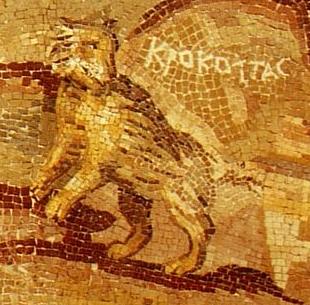
A "stuffed" griffin from the Copenhagen Zoological Museum (via Wikipedia)
Famous examples include the Fiji mermaid, a grotesque combination of a monkey and a fish;
The skavader, a fictional Swedish creature, and the jackalope, a creature from North American folklore. Such hoaxes were very common, especially in the case of medieval monsters and mythical beasts, so much so that when the Australian platypus was first discovered, people assumed it was a stuffed fake.
Image of the Fiji Mermaid from Wikipedia, see link above
The term "rogue taxidermy" was invented by the Minnesota Association of Rogue Taxidermists, a group who specialise in artificial oddities. When they first exhibited, the New York Times ran a feature on their work, including Sarina Brewer's brilliant roadkill creation, the "Goth Griffin" (below)
Here's a selection from their 2010 exhibition, with more images from the show here.
A similar idea can be seen in the delicate and strangely appealing bone and metal creations of Jessica Joslin
There has been a lot of controversy about these pieces, however. Some taxidermists and audiences accuse the artist of not respecting the animals that are being used to create the pieces. However, since many artists, such as Sarina Brewer and Scott Bibus only use "found" animals (usually roadkill), I personally beleive there is greater respect for the animal than in conventional taxidermy, which often uses hunting trophies. Beyond that, I see a similarity with practices of indigenous peoples in North and South America and in ancient Egypt; using the remains of an animal to create pieces that are both beautiful and have deep spiritual or symbolic meaning. I strongly beleive that using otherwise "leftover" parts of animals shows is a fitting tribute to that creature.
I really enjoy this sort of work. Taxidermy has become a fairly common sight in fine art installations thanks to the work of artists like Damien Hirst and Polly Morgan, but I particularly respect the skill required to create a convincing rogue piece, as well as the dark humour of many such pieces. I'm considering adding an aspect of rogue taxidermy to my Egyptianising theme. Taxidermy and mummification, although practiced for different purposes, are fairly similar. Rogue taxidermy reminds me of the Egyptian mummies of animals such as hawks, rams and cats, which were often arranged to resemble the basic mummiform shape of a mummified person. Both practices are about preserving the dead and giving the corpse the sembulance of life.
I also like the idea of using rogue taxidermy to create mythical creatures, though the beasts typically created have Christian and Graeco-Roman subjects; it would be interesting to create a piece that references Egyptian daemons and deities, such as Ammut, but has the feel of rogue taxidermy.
In my motif project I drew heavily from ancient Egyptian art and burial practices, so for this project I need to develop those ideas. Here are some links to information and images from both modern and ancient Egyptian creatures.
The tomb chapel of Nebamun, an 18th dynasty accountant of Amun, was decorated with beautiful, incredibly detailed paintings, including one of the best examples of the typical hunting and fishing scenes. The detail of the birds' wings, the papyrus and lotus fronds and the markings of the cat were heavily influenced by the notorious Amarna period, which is characterised by stylised human forms and naturalistic flora and fauna.
You may have gathered from some of my earlier posts on this blog that I love history. In the context of art, I'm very interested in what art and design meant to different cultures at different times. One period I'm eternally fascinated by is inter-war Germany; the stark contrast between the artistic freedom of the Weimar Republic, with it's subversive caberets and vibrant expressionist, and the very ordered design of the Nazi party, with it's clean lines and exquisite tailoring. I'm always amazed by Nazi art and design; I've always believed that the power of their propaganda, their stirring music and their elegant design was key to their rise to power.
So here's a fascinating link to a rare find: a graphic design "bible" produced by the Nazi party in 1936 (click the link on the page to download and view the full book). Complete with full colour illustrations of uniforms, badges and flags, along with masses of flow diagrams, town plans and all written in a beautiful Blackletter font. Of course it's in German, but even if you don't read German (and I certainly can't) it's very interesting if you're interested in uniforms, military fashion, or symbolism. Yes, it's a bit macabre but it's incredibly interesting.
I know this isn't really related to the flora and fauna brief we're working on at the moment, but it is textiles related and there are some plants and birds in the iconography. I'm very tempted to play around with a morbidly Nazi repeat pattern. We all have those "Springtime for Hitler" moments sometimes!
This series of lesson plans looks at the relationship between art and mathematics in pattern design. With sections on traditional non-European art styles, such as Islamic patterns and Indian Mandalas, as well as famous artists for whom pattern was a key part of their style, such as Escher and Klimt. There's also a section on the history of the use of pattern in art, which goes right up from Prehistoric cave paintings right up to modern art, which is very interesting, and pretty relevant for me as I'm thinking of using Egyptian styles again.
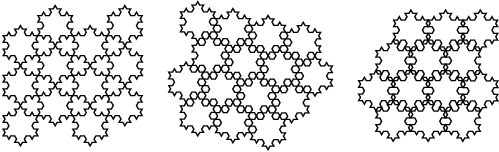
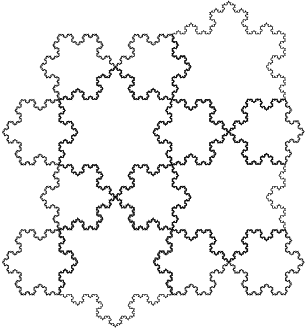
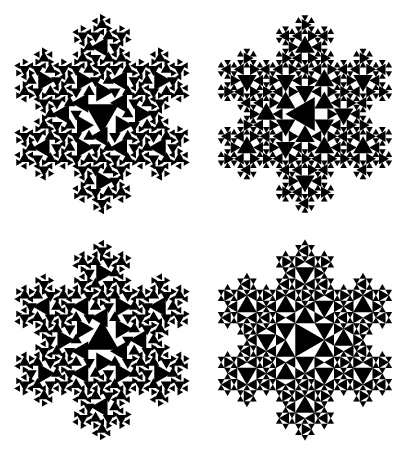
Fractals are complex, often chaotic, geometric shapes which divide into parts which are smaller-sized versions of the whole thing. In maths they are used to describe certain graphs and geometric principles, but they also make beautiful art. You can see them in nature in ferns
The Textile Blog is an excellent resource for images and thoughtful, fairly accurate articles on various famous textile designers. It's largely an art history based site, as far as I can tell, but it looks at some quite unusual subjects, such as lace design. There's lots on wallpapers, rugs, tapestries and suchlike which could be very useful for repeat pattern ideas.
Our current textiles project is looking at repeated patterns, so now seems like a good time to look a some ways of creating repeats.
Block patterns: "Divide and conquer" method
I call this method "divide and conquer" because it involves cutting you4r design into quarters. This tutorialcovers it very well: draw a large design in the centre of your paper, cut into four VERY ACCURATELY and stick back together so that the white space at the edges of your design becomes the middle of the paper. Now draw something to fill in the white spaces. Because your original design was at the edge of the paper you can now join it up.
This tutorial covers the same process but in photoshop.
Geometric patterns: Tessellations
Tessellating shapes are shapes that can fit perfectly together. The 20th century Dutch artistMC Escher was famous for (among other things) very complex geometric designs like this:
Escher's designs look very complex but were made using simple mathematical principles. He took shapes that tessellated (such as squares, equilateral triangles and hexagons), cut shapes out of their sides and re-arranged them to create more complex shapes. Scroll down here to see his designs simplified to their base shapes. Here's a very handy tutorial from a very excited maths teacher
And here's a fun website where you can mess around with tessellations. I made a few quick ones myself, and they look something like this
Although they look relatively complex, they're made entirely from triangles and squares.
Software
Today artists have a vast range of tools that can make designing repeat patterns a whole lot easier. Editing software like Adobe Photoshop and vector software like Adobe Illustrator can create complex patterns with just a few clicks. I've never used Illustrator, so I won't be looking at it here but oddly 50% of the hits that come up if you google repeat patterns are Illustrator and vector tutorials.
This I found in a chairty shop a while back. I apologise for the dreadful picture quality, but you can just about see the lovely Indian-style repeat embroidery pattern.
Embroidered in satin stitch it gives the jacket a glossy quality, while the bold yellow and deep purple colour scheme are really eye-catching with panels of simpler and more complex patterns.
These fabulous watercolour-toned tye-dyes from SHABD are gorgeous. I'm not entirely sold on the cut of the garments, but the colour pallet is stunning.