Showing posts with label research. Show all posts

Sunday, 6 March 2011

The Tree of Life

On to my next project; this time looking at the concept of the Tree of Life. The Tree of Life, or World Tree, is a basic concept that appears in many cultures throughout history. In Chinese mythology the tree's branches support a phoenix and a dragon and represents immortality. In the Near East, from the Bronze Age onwards, the tree was a religious symbol that was so common in art that the early Greeks copied it in their own art.

Image from Wikipedia

In Judaism and Christianity, the Tree of Life is the tree that bears the fruit that gives knowledge of good and evil in the Garden of Eden, while in the Jewish esoteric tradition of Kabalah, the "Tree of Life" is a mystic symbol that plots the path to HaShem (God)
Image from Wikipedia

In Christianity, the tree of life is also used in imagery of the crucifixion, and as with Chinese mythology it's a symbol of rebirth.
Image from "Godzdogz" blog

The Tree also appears in Mesoamerican religions, such as those of the Aztecs, Incas and Mayans, as the world tree.
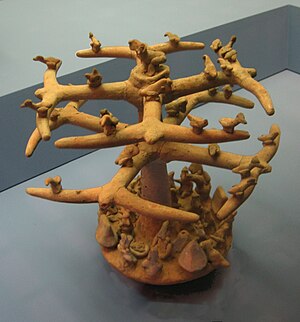
Image via Wikipedia

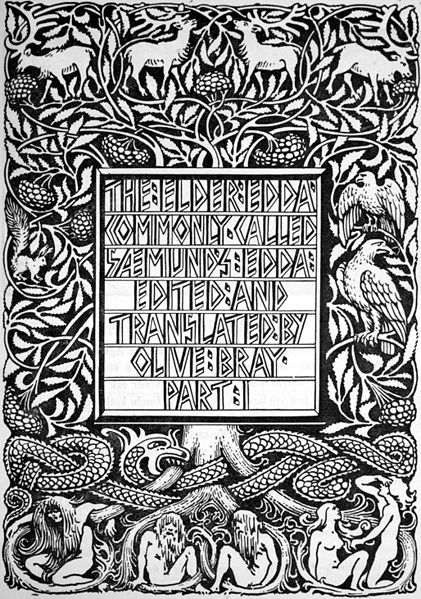
However, one of the best known uses of "Tree of Life" imagery comes from Norse mythology where it was central to the beleifs of the peoples of Scandanavia and Germany. Yggdrasil, the Great Ash Tree, supported the heavens (Asgard) in its branches, where the gods gathered to hold court, while its routes stretched to the earth (Midgard), the underworld (Niflheim) and hell (Hel). The dragon Niohoggor coiled in its routes, an eagle roosted in its branches, and four sacred stags walked its boughs. A squirrel ran up and down its trunk relaying messages between its roots and its branches.
Images from Wikipedia

More images of representations of Yggdrasil can be found here though the text is in Spanish.

Today the Tree of Life is a popular image in art and is a term used to describe diagrams explaining evolution in science.
A painting of the Tree of Life by Klimt from 1909.

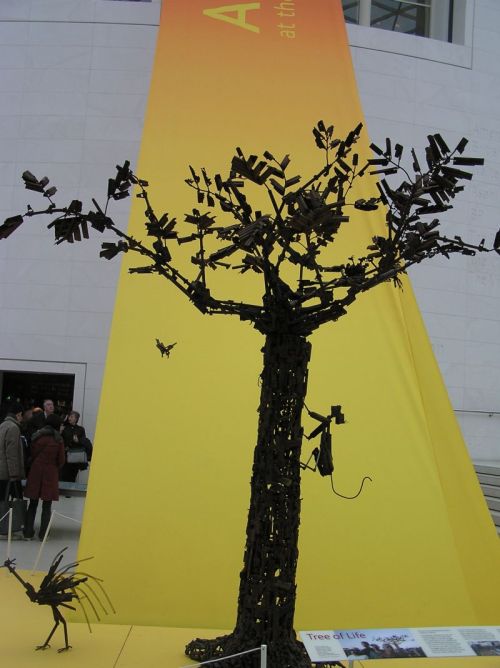
This sculpture made by Mozamican artists Kester, Hilario Nhatugueja, Fiel dos Santos and Adelino Serafim Maté was made from decommissioned weapons including AK-47s, pistols, rifles and rocket-propelled grenades. More can be found out here.

Due to its rich history and spiritual meanings, the Tree is a very popular motif for tattoos, often incorporating celtic knotwork.
Image from SPC Tattoo

Thursday, 17 February 2011

Repeat Pattern Concept and some photoshop doodling

Following on from the themes I've been researching and working with so far, I've settled on a concept for my final repeat which is based on the Egyptian concept of Duat, the Underworld. When a person died, they beleived that they would travel through Duat, coming up against various tests and dangers, which could be defeated with use of the spells catalogued in the "Book of Coming Forth By Day", or as we call it, "The Book of the Dead". At the climax of the journey, the dead person's heart would be weighed against the feather of Maat, which represented truth and justice. If they were judged just, they would be allowed to enter the realm of Osiris where they would live for eternity in comfort, but if the heart was rejected it would be eaten by the monster Ammut, "The Devourer" amd the dead person would be doomed.

The journey through Duat, with the Weighing of the Heart, in particular is fairly familiar thanks to the restoration of some very beautiful Book of the Dead papyri. I was lucky enough to get to see some of them in person at the British Museum's Book of the Dead exhibition this winter, and it's clear from some of the more bizarre vignettes and the gruesome annotations that Duat was a very frightening place. We tend to think of the Egyptian views on the afterlife as strange but beautiful because of the very ordered vignettes from the Book of the Dead papyri; the faces of the human figures are expressionless, almost mask-like, and the daemons tend to be shown in rest, waiting for the deceased person to come to them, so that the more distressing elements are left unseen.

I want to create a repeat pattern that highlights the frightening, disordered and gruesome elements of Egyptian afterlife beliefs, combining Egyptianising motifs with images we associate with death today, such as bones and skeletons. I plan to create a design that appears random as to Egyptians chaos was synonymous with evil and was a terrifying idea that threatened their way of existence (the villianous deity Seth was god of chaos, linked with the serpent of darkness Apep, while Maat was the goddess of justice, order and truth).

Today, I started drawing some of the images I will use for this piece, and had a quick experiment with brushes I created from them. Here's the result.

Wednesday, 16 February 2011

Animals in Egyptian Hieroglyphs

Egyptian hieroglyphs include a vast number of ideograms depicting animals, both real and mythical, and parts of animals. Plants are depicted too, but they are often so stylised it is difficult to see what they were intended to represent.

Hierolgyphic script was only used for special occasions and expensive items, such as high quality funerary goods and manuscripts, because it was so difficult to write. Grammar was very complicated and there were hundreds of separate ideograms which could stand for one word or one syllable depending on context. Scribes had to train for years just to be able to accurately copy manuscripts. Artists also seem to have had a basic knowledge of the ideograms, as the stylised signs themselves appear frequently within vignettes depicted in tomb paintings and temples, even in jewellery (see Wilkinson: Reading Egyptian Art)

The English Egyptologist Sir Alan Gardiner created a table of signs which he divided up thematically in terms of what the ideograms depicted, which includes a number of mammals, reptiles, amphibians, birds and plants. This is useful for a number of reasons; it provides a comprehensive list of creatures that were recognisable to ancient Egyptians, but it also it provides a quick glossary to the stylised forms.

It's interesting to note that the vast majority of the creatures depicted are real animals rather than mythical beasts, with the benu bird and the Seth animal being notable exceptions (although even the benu bird is based largely on a heron).

More images of the Fauna of Egypt

All images are from Wikipedia unless otherwise stated. I know it's not the most reputable of sources but it's always a good starting point and you can't go wrong with a good picture. This time I want to look specifically at skeletons and skulls.

Hippotomus
 Lion
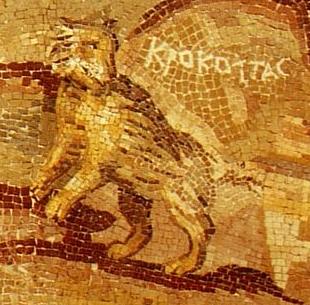
 Crocodile
 Egyptian Wolf/Jackal
 Horned Viper
(Image via)
Hyena

Hellenistic mosaic depicting a striped hyena.


As I mentioned in my last post, I'm thinking of working on a design featuring animals and daemons of ancient Egyptian folklore. I want to use realistic depictions of skeletons, stylised Egyptianising flora and possibly some fairly realistic studies of insects (particularly scarabs) and snakes. It's an idea I'm only just starting to properly shape, but it's developing.

Tuesday, 15 February 2011

Flora and Fauna of Egypt

In my motif project I drew heavily from ancient Egyptian art and burial practices, so for this project I need to develop those ideas. Here are some links to information and images from both modern and ancient Egyptian creatures.


Animals in Ancient Egyptian art (above images from this page)

The tomb chapel of Nebamun, an 18th dynasty accountant of Amun, was decorated with beautiful, incredibly detailed paintings, including one of the best examples of the typical hunting and fishing scenes. The detail of the birds' wings, the papyrus and lotus fronds and the markings of the cat were heavily influenced by the notorious Amarna period, which is characterised by stylised human forms and naturalistic flora and fauna.

Creatures of Egypt today