Showing posts with label repeat patterns. Show all posts

Friday, 18 February 2011

Final piece - Duat

At last the Duat piece is done. I made some changes to my original plan, but I'll discuss those in a bit.

I started off by drawing the images I wanted to include in the design. The most challenging was the skeletal version of Ammut, the composite daemon who eats the heats of the unworthy. To create her I broke her down into the three animals she is made up of: a crocodile's head, a lion's shoulders and a hippopotamus' hindquarters. I then found images of the skeletons of each of these animals and created Ammut's skeleton by putting these together.
I wanted her to look threatening and disturbing, so I chose an open-mouthed crocodile skull and a twisted pose.

Once I had the images I wanted to use, I made brushes out of them in photoshop and started to work on the image. As I liked the effect of the bleach drawings and the X-ray like quality of the white on black images I had done before, I decided to apply white brushes onto a black background. I started with my central motif: Ammut standing above a heart framed by a structure comprised of snakes and papyrus fronds. I wanted to give the frame an architectural feel similar to the depictions of temples and shrines in the Book of the Dead but to have it made of organic forms.


I considered adding a reference to the Weighing of the Heart, with perhaps scales, but I decided that it would be more effective to focus on organic forms and to leave out any imagery associated with order, virtue or the divine. As such I decided against including imagery associated with any of the gods, such as jackals, baboons, the Seth animal or birds.

Once I had the central image sorted, I ensured the design was properly centred, added white guidelines and then a series of snakes at diagonals to add a diamond pattern
To test that the snake diagonals lined up, I tested the image as a pattern

The result had a nicely archaic feel. It reminds me of 18th century wallpaper designs. However it didn't quite capture the sense of threat and fear that I wanted so I added brushes based on dangerous animals common in Egyptian art, especially in images of Duat: scorpions and hippotomi. I considered adding a crocodile, as crocodile daemons are very common but decided that that might detract from the crocodile that made up Ammut's skull.

Originally I tried adding a smaller scorpion but I felt that it didn't make use of the space very well. Once the design was finished, I tested it on a large area once again.
Although the repeat itself is fairly simple, being nothing more than a block repeat, I like the geometric feel that the blocks and diamonds create. Like the first test image, the piece has an old-fashioned feel which suggests the influence that Egyptian art has had on the development on art in the Western world, being the original inspiration for ancient Greek sculpture, relief and painting which is the backbone of Western representational art. Like the original vignettes from the Book of the Dead, it is both elegant and ordered and disturbing.

In my last blog post I wrote that I planned to make a very disordered repeat to hint at the Egyptian fear of chaos, but after looking at the art and literature of the Book of the Dead once more I remembered that Duat is a fairly ordered and linear place, however disturbing. The Book of the Dead acts as a map, showing the deceased the path through Duat to the houses of the Underworld gods, and as such it shows the order there as a person can only reach their goal by following it. Duat is ruled by deities who represent order. Osiris, Anubis, Isis, and Ra all have duties there, but certain daemons are hinted to be sent to attack the deceased by Seth, god of chaos: order rules but chaos has influence. However, to hint at the fear of chaos, I ensured that there was an element of instability in my piece by making diamond shapes different sizes, which tricks the eye and adds a sense of nervousness. I made sure the diagonals continue fluidly through the piece, though, to suggest the path through Duat, with the winding spines of the snakes suggesting the complex journey past the many dangers towards the "climax": the Weighing of the Heart.

I think the white-on-black Duat design would make a good pattern for a statement wallpaper. If reduced in size and printed onto a heavy fabric it would make an interesting, subtle pattern for a skirt. It would be interesting to try printing it black-on-black onto velvet to create a subtle relief pattern, and I think the dark but glossy qualities of black velvet would suit the subject matter and heighten the unsettling feel of the subject matter.

I experimented with changing the colours but I think the white on black scheme is the strongest, adding a modern twist to a design that draws so heavily from the past.


I do quite like the effect on this last one, however,. The blue-tones against the white are suggestive of 18th century porcelain.

Thursday, 17 February 2011

Repeat Pattern Concept and some photoshop doodling

Following on from the themes I've been researching and working with so far, I've settled on a concept for my final repeat which is based on the Egyptian concept of Duat, the Underworld. When a person died, they beleived that they would travel through Duat, coming up against various tests and dangers, which could be defeated with use of the spells catalogued in the "Book of Coming Forth By Day", or as we call it, "The Book of the Dead". At the climax of the journey, the dead person's heart would be weighed against the feather of Maat, which represented truth and justice. If they were judged just, they would be allowed to enter the realm of Osiris where they would live for eternity in comfort, but if the heart was rejected it would be eaten by the monster Ammut, "The Devourer" amd the dead person would be doomed.

The journey through Duat, with the Weighing of the Heart, in particular is fairly familiar thanks to the restoration of some very beautiful Book of the Dead papyri. I was lucky enough to get to see some of them in person at the British Museum's Book of the Dead exhibition this winter, and it's clear from some of the more bizarre vignettes and the gruesome annotations that Duat was a very frightening place. We tend to think of the Egyptian views on the afterlife as strange but beautiful because of the very ordered vignettes from the Book of the Dead papyri; the faces of the human figures are expressionless, almost mask-like, and the daemons tend to be shown in rest, waiting for the deceased person to come to them, so that the more distressing elements are left unseen.

I want to create a repeat pattern that highlights the frightening, disordered and gruesome elements of Egyptian afterlife beliefs, combining Egyptianising motifs with images we associate with death today, such as bones and skeletons. I plan to create a design that appears random as to Egyptians chaos was synonymous with evil and was a terrifying idea that threatened their way of existence (the villianous deity Seth was god of chaos, linked with the serpent of darkness Apep, while Maat was the goddess of justice, order and truth).

Today, I started drawing some of the images I will use for this piece, and had a quick experiment with brushes I created from them. Here's the result.

Thursday, 10 February 2011

Patterns with a morbid background (EDITED)

Remember that link I posted to the Nazi design manual? I decided to try to make some repeat patterns using some of the images from the badges and pins illustrated in the manual. I wanted to go for a fairly conventional repeat to contrast with the dark source. Here are my first attempts.

For this design I wanted to create something that looked fairly traditional, inspired by the very ordered but very busy designs of Victorian wallpapers. I wanted to suggest that images are corruptible when used in a different context. The Nazi party themselves took traditional images and bent them to their purposes: the swastika is a pre-Christian good luck symbol (still used in some Buddhist and Hindu art but now out of use in the West for obvious reasons), the eagle motif was inspired by ancient Roman military symbols and so on. I wanted to take these motifs and turn them into something beautiful to subvert their source and to hint at the persuasiveness of the Nazi propaganda machine.


The leaves are from patches that would have been sewn onto the collar of an officer, the eagle is from a medal. I think the first pattern, with the vertical stripes, is more effective that the second; it was difficult to make the pattern feel balanced and ordered with the more random style. Although this design is slightly more disordered than I would like, the basic concept I was playing with here still shows: turning the very ordered, clean designs of the originals into something more fluid and organic. I wanted to suggest that over time these motifs could outgrow their source material and take on new meanings.

The original images are

This Bug's Repeating

Repeat patterns. With bugs.


Tuesday, 1 February 2011

More Photoshop!

This time I've been making patterns and brushes out of drawings I scanned in.
First I made brushes by simply selecting the area of the drawing and changing the colours through the "levels" option

Then I made some pictures with those brushes


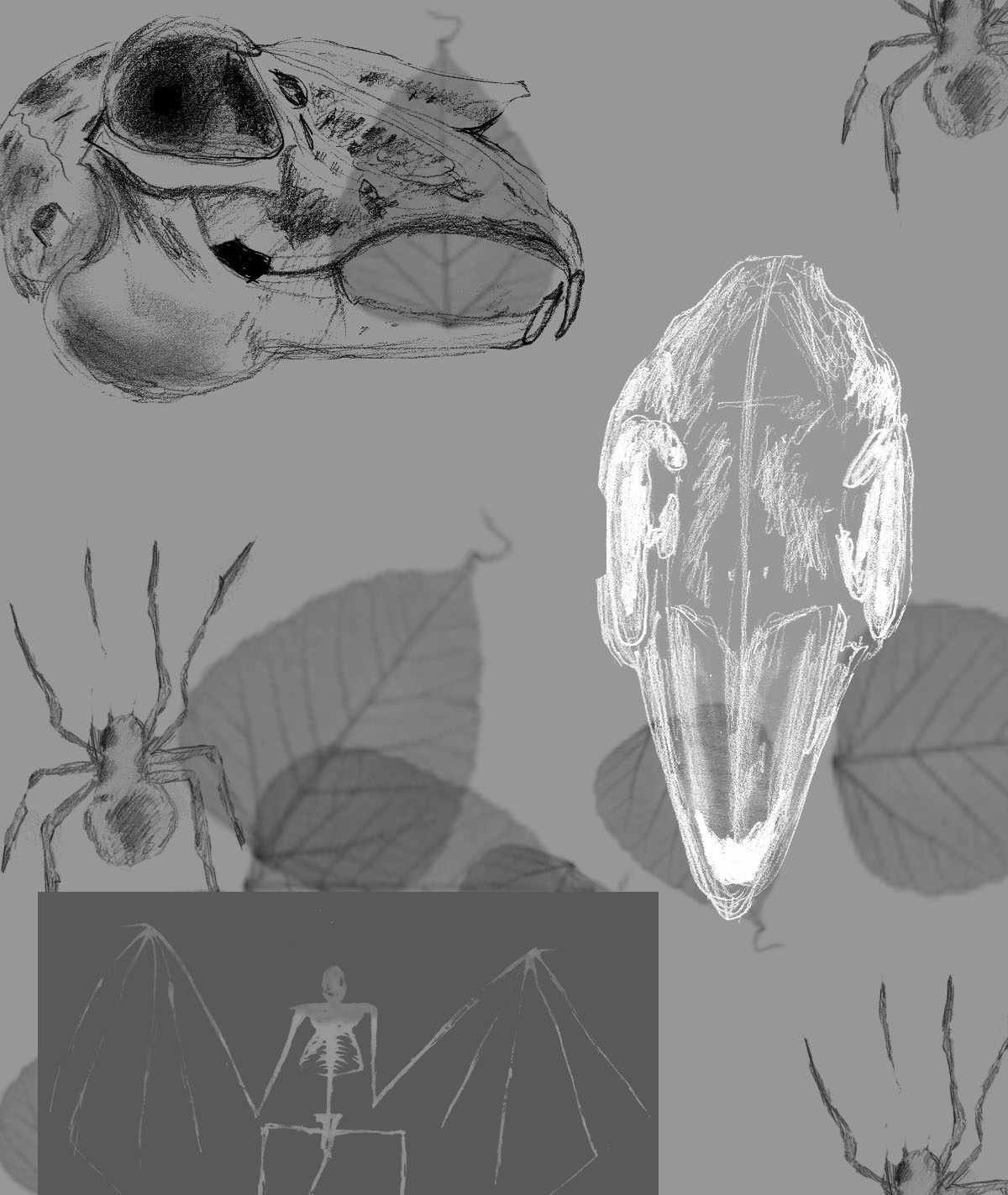
 Then I tried making some patterns with the original images. This is a half drop of a hare's skull drawn in bleach on ink
 Half drop bat skeleton
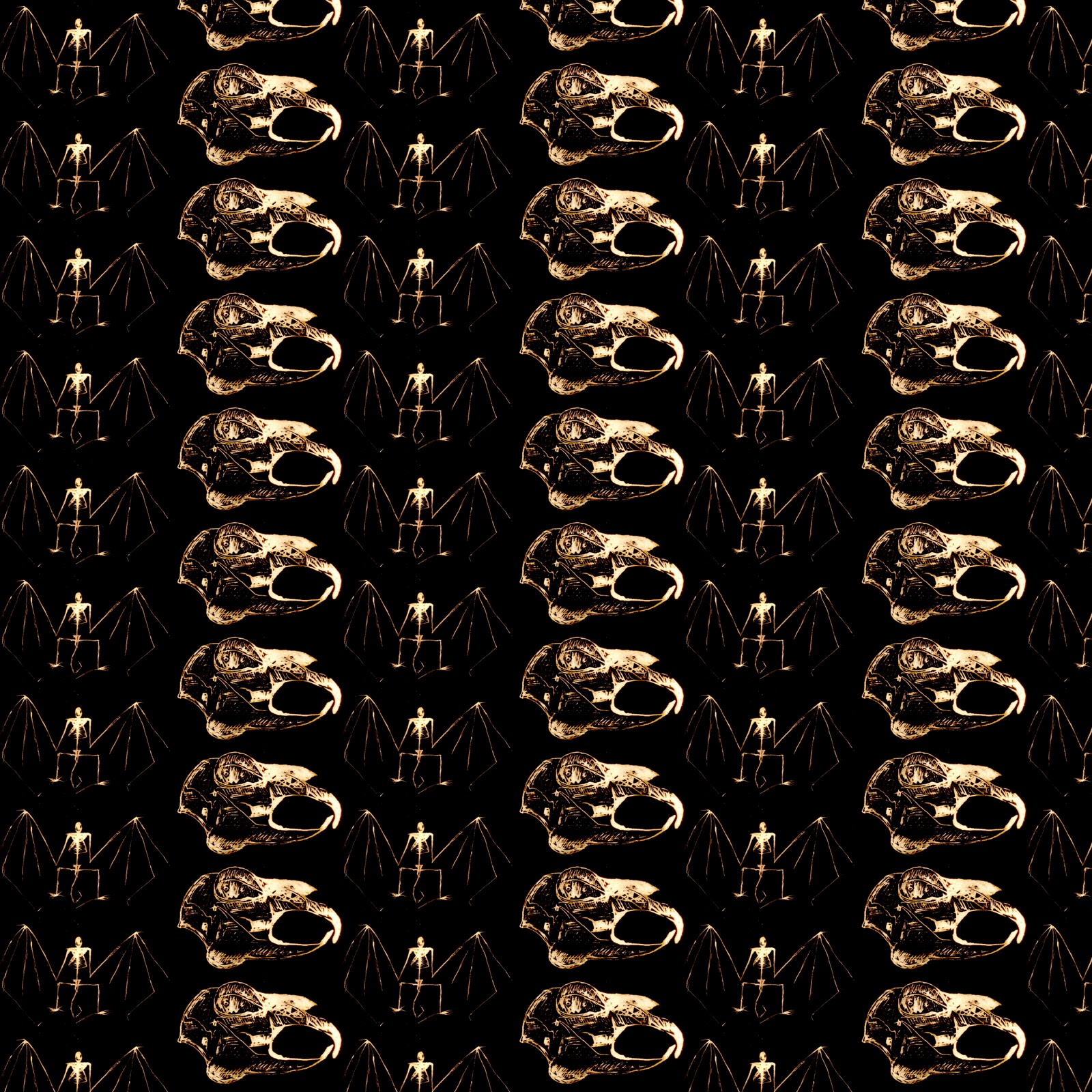
Half drop of the bat and the skull together

And finally I took an old painting and made a half drop pattern using the healing tool to merge the seams.

Photoshop Patterns

Experimenting with pattern making in photoshop.
First I created some of my own brushes
Then I made a simple block pattern with some
 Then I made a half-drop pattern using wrap-around filters


 Using colour and shape dynamics, I layered brushes to create busier and more complex patterns


Then I experimented with using the patterns to fill shapes

Monday, 31 January 2011

Yet another interesting link

This series of lesson plans looks at the relationship between art and mathematics in pattern design. With sections on traditional non-European art styles, such as Islamic patterns and Indian Mandalas, as well as famous artists for whom pattern was a key part of their style, such as Escher and Klimt. There's also a section on the history of the use of pattern in art, which goes right up from Prehistoric cave paintings right up to modern art, which is very interesting, and pretty relevant for me as I'm thinking of using Egyptian styles again.

More Mathematical Patterns: Fractals

Fractals are complex, often chaotic, geometric shapes which divide into parts which are smaller-sized versions of the whole thing. In maths they are used to describe certain graphs and geometric principles, but they also make beautiful art. You can see them in nature in ferns
electrical discharges
and Romanesco broccoli, to name but a few
(images from http://www.miqel.com/fractals_math_patterns/visual-math-natural-fractals.html )

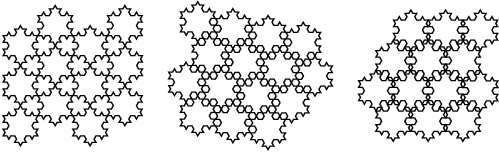
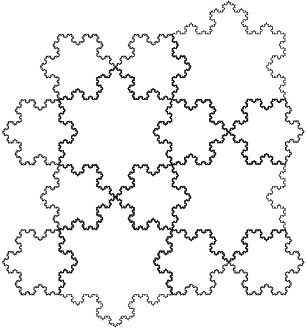
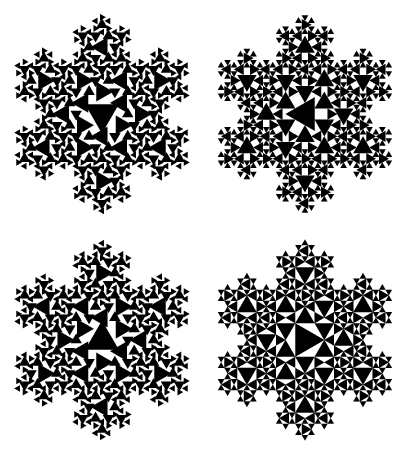
Examples llike the Koch Snowflake can be used to create beautiful tiled patterns like these from Mathworld

Another useful link

Looking at using different types of repeat to create different patterns with the same base image. This tutorial gives examples making some nifty pattern using nothing more elaborate than the letter P (images below taken from that website).
Basic block pattern
Half Drop
Reflections
Basic Rotations
And some rotations of different degrees
Rotations combined with reflections

Ways of making repeat patterns

Our current textiles project is looking at repeated patterns, so now seems like a good time to look a some ways of creating repeats.

Block patterns: "Divide and conquer" method
I call this method "divide and conquer" because it involves cutting you4r design into quarters. This tutorial covers it very well: draw a large design in the centre of your paper, cut into four VERY ACCURATELY and stick back together so that the white space at the edges of your design becomes the middle of the paper. Now draw something to fill in the white spaces. Because your original design was at the edge of the paper you can now join it up.


This tutorial covers the same process but in photoshop.

Geometric patterns: Tessellations
Tessellating shapes are shapes that can fit perfectly together. The 20th century Dutch artist MC Escher was famous for (among other things) very complex geometric designs like this:
Escher's designs look very complex but were made using simple mathematical principles. He took shapes that tessellated (such as squares, equilateral triangles and hexagons), cut shapes out of their sides and re-arranged them to create more complex shapes. Scroll down here to see his designs simplified to their base shapes. Here's a very handy tutorial from a very excited maths teacher
And here's a fun website where you can mess around with tessellations. I made a few quick ones myself, and they look something like this

Although they look relatively complex, they're made entirely from triangles and squares.

Software
Today artists have a vast range of tools that can make designing repeat patterns a whole lot easier. Editing software like Adobe Photoshop and vector software like Adobe Illustrator can create complex patterns with just a few clicks. I've never used Illustrator, so I won't be looking at it here but oddly 50% of the hits that come up if you google repeat patterns are Illustrator and vector tutorials.

Using Photoshop you can make repeat patterns from photographs and from complex images. I'll be uploading a few of my own photoshop patterns in the next few days.

More on repeats coming soon!